Autumn / Winter
2001 Menghai 7542, raw Pu-erh
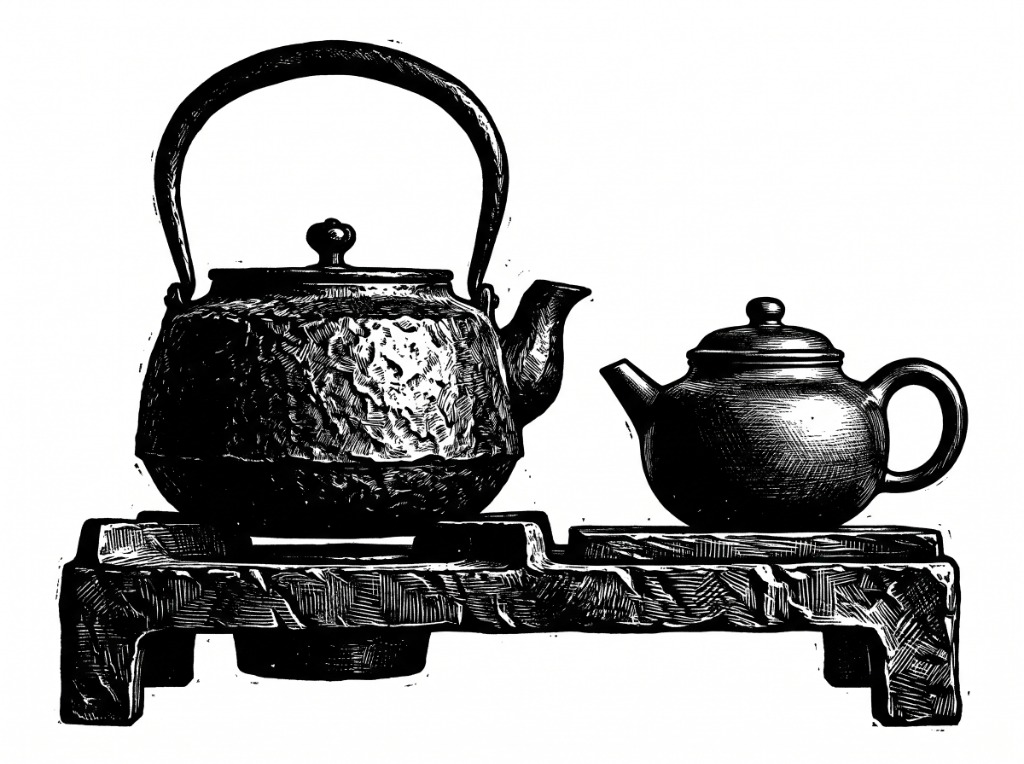
1970s Yixing Hongni · Meiji iron kettle over live flame
Pithless lemon, green cardamom & vanilla confit
Fermented wild berries
Charcoal-roasted Wuyi Rougui
Antique Chaozhou Zhuni · 19th-century Edo porcelain
Water mineralized in-house to 45 ppm. Two hours, twelve infusions.
Spinning this month: The Goat Rodeo Sessions & 1970s Anatolian vinyl.
Seatings
Sundays at 14:00 and 16:30. Four seats per table.
Please arrive without perfume or cologne. Exact street door is shared the day before.
November is full. December seats open November 25.
Notes
Most rooms in a city are engineered around the steady removal of resistance. You scan a code at the table, order from glass, eat beneath a playlist calibrated to keep conversation brisk, and settle the bill without catching anyone's eye. Everything arrives frictionlessly, and almost nothing stays with you once your coat is back on.
When we began pouring tea around a single table in Midsommarkransen, we wanted to see what happened if we went the other way. There is no sign on the street. Water heats over live charcoal in heavy nineteenth-century cast iron, which means the kettle has to be listened to as its pitch drops from a rattle to a low sigh rather than held at a digital number.
A tightly compressed 2001 Pu-erh cake pushes back in the same way. Its first two infusions are reticent, still folded around twenty-five years of storage. Only around the fifth or sixth steep do the leaves yield, the liquor thicken, and the pace in the room drop on its own. Nobody has been asked to be solemn. It is simply hard to hurry something that refuses to open in under two hours.
Walk into a tasting room or a specialty bar and you are usually handed a small lexicon before your cup is poured: bergamot, wet slate, baked pear, cedarwood. What falls inside that beam of words suddenly leaps out on the palate—real enough, yet strangely crowding out everything left in the dark.
Attention behaves less like daylight and more like a pocket flashlight in an unlit room. Wherever you point it, what you see is genuinely there, which makes it very easy to mistake the narrow circle for the whole floor.
Turn the beam away from tasting nouns—toward weight, or cooling aroma, or water mineralized to forty-five parts per million—and another room appears altogether. You notice how water boiled in unlined iron sits fuller along the sides of the tongue than water from steel, and how a faint camphor sweetness returns in the throat half a minute after an Edo porcelain cup is already dry.
All of us carry a tiny press secretary in our heads—a practiced voice ready to summarize what we think of a record, a bottle, or a room the instant we recognize its label. Tell someone they are drinking a famous 2001 factory cake or a cliff-grown Wuyi oolong up front, and the press office immediately starts drafting talking points out of things read years ago.
Pour the same leaf without provenance chatter and that machinery stalls in the most welcome way. In the silence before anyone knows whether a tea is rare or ordinary, you are left with much simpler facts: the smell of warm wet wood rising from thin red clay, a slight tightening across the gums, the surprise of apricot skin on the fourth steep when the bitterness suddenly clears.
That is most of why we keep the table to four chairs and the printed menu to six lines. Once the urge to sound informed has nowhere to perform, four strangers can sit over hot water on a dark Stockholm afternoon and say only what they actually taste.